CHIENHO
Get a Quote
CHIENHO
August 2026 · 7 min read
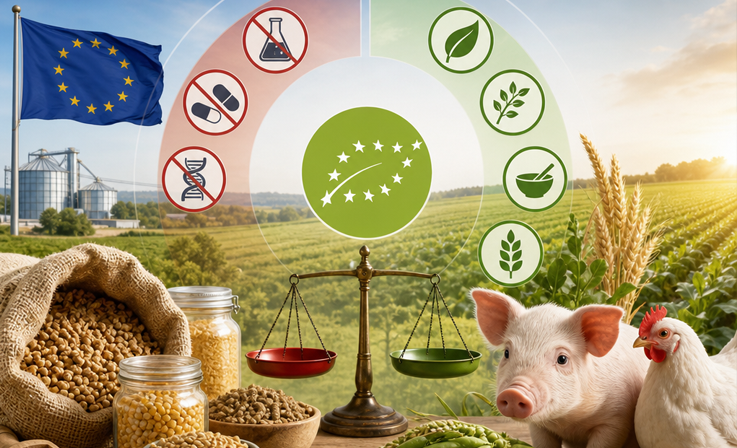
📎 This article is based on Jiang Tianxue, Legal Norms for Feed and Animal Nutrition in EU Organic Agriculture, China Feed, 2020(12), restructured with the latest (EU) 2025/973 revision and industry observations, for domestic organic feed practitioners.
Why EU Organic Feed Regulations Are Worth Re-reading
The EU is the world's second-largest stand-alone market for organic agri-products and the region where the organic regulatory framework started earliest and gets revised most frequently. From the first organic standard in 1991, through EC 834/2007 and EC 889/2008, to the 2018 new regulation and the 2025 refresh of the additive list via (EU) 2025/973, every round of amendment responds to two tensions: rising consumer-fraud residues vs. pressure to localise organic supply chains.
For domestic enterprises making organic pig/poultry feed or exporting organic agri-products to Europe, the EU framework is an unavoidable benchmarking target: its "negative list" is stricter than most Chinese standards, its "positive list" is more granular, and after the 2018 reform the third-country equivalence rule was abolished—every batch now has to be re-assessed against the EU list.
The Underlying Logic: Organic Livestock Is Not Just "No Antibiotics, No GMO"
The European Organic Regulationsets three tone-setting rules for animal production—formulators and buyers should keep them in mind:
1. Crop–Livestock Cycling Is a Hard Constraint
An organic production unit must be able to feed its own animals—usable land area must match herd size, animals must have free movement, manure must be harmless-treated, and overgrazing prevented. For herbivorous animals, roughage ≥ 60% of the diet; for sheep, pigs, goats, priority is given to maternal milk for the first 40 days (longer for ruminants).
2. Feed Sourcing: "Local First"
On-unit feed > regional feed > third-country feed. The 2018 reform quantified this:
3. The "Stacked" Red-Line List
Beyond the well-known zero tolerance for GMOs and derivatives, and bans on growth promoters / routine anti-parasitics / antibiotics for growth promotion, several easily overlooked items:
The Regulatory Architecture: 4 Main Regulations + 1 Basic Act
EU organic feed is not governed by a single text, but stacked as "1 Basic Act + 4 main regulations + N granular revisions":
| Tier | No. | Governs |
| Basic Act | Regulation (EC) No 178/2002 (General Food Law) | Farm-to-fork, incl. RASFF (Rapid Alert System for Food and Feed) |
| Organic Mother Law | Regulation (EC) No 834/2007 | Organic production principles & objectives (originated 1991) |
| Implementing Rules | Commission Regulation (EC) No 889/2008 | Production, processing, import, labelling; enzymes, transition-phase feed, organic yeast |
| Import Rules | EC No 1235/2008 / (EU) No 126/2012 | Third-country organic product access |
| Additive Mother Law | Regulation (EC) No 1831/2003 (Feed Additive Regulation) | Pre-market approval, positive list, specific licence holders |
Granular revisions directly relevant to feed deserve separate mention:
⚠️ After the 2018 reform, the "equivalence rule" was abolished within a 5-year transition—meaning third countries (including China) can no longer ride on "our standard is equivalent to yours" when sending organic products into the EU; every item must be benchmarked line-by-line against the EU list. This hits Chinese organic soybean, peanut, and soybean meal exports most directly.
The "Positive List" of What Organic Feed May Use (the most practical part)
Commission Regulation (EC) No 889/2008 lists permitted organic feed materials in unusual detail—formulators can benchmark directly. Excerpt below focuses on monogastric (pig, poultry) relevance:
Animal-source (pig/poultry OK; ruminant-restricted ones omitted):
Plant-source (the bulk):
Mineral-source:
Magnesium chloride, magnesium sulphate, defluorinated dicalcium phosphate, calcium lactate, sodium bicarbonate, mineral salt, sodium sulphate, etc.
⚠️ Two hidden thresholds:
Additives: 1831/2003 Is a Separate Logic
Many confuse "additives inside organic rules" with "general feed additive law". Regulation (EC) No 1831/2003 is the EU mother law for allfeed additives—divided into zootechnical, technological, and nutritional categories; antibiotic growth promoters are fully banned; medicinal feed additives and processing aids are outside its scope.
Additives usable in organic rations must pass two gates:
This is why heat-stable phytase is still not in EU organic rations—it is not blocked by 1831, but by the organic-specific list. The 2025/973 round did notlet it in either; only propylene glycol salts (refined), ferrous fumarate (newly listed), lecithin (newly approved), and calcium stearate (re-authorised) moved.
Down to Monogastrics: Three Practical Points Under the Framework
🐔 Broilers: slow-growing breed + outdoor foraging + starter 5–10% fishmeal to cover methionine = the combination that works in Europe. The regulation does notblock fishmeal (pig/poultry OK); what it blocks is synthetic AA—methionine hydroxy analogue, the conventional go-to, is basically gone in organic, so you have to brute-force with fishmeal + soy, pushing cost up and risking protein excess.
🐖 Pigs: starter also 5–10% fishmeal, slow-growing breeds preferred. The rule "priority maternal milk for 40 days" compresses the artificial milk replacer window, making whey powder / milk protein (animal-source items on the positive list) critical.
🥚 Layers: relatively relaxed; the "roughage ≥ 60%" rule for chickens is mostly delivered via pasture ranging, while wheat+barley+maize+soy+sunflower in the ration is enough. Synthetic pigments are notallowed—paler yolks must be compensated with alfalfa concentrate or prairie meal (low-starch corn concentrate by-product); marketing teams need to align expectations upfront.
Three Takeaways for Domestic Practitioners
The EU framework has been running 30+ years, and the core hasn't changed: organic is not "conventional agriculture with less pesticide," but the legalisation of an alternative production system. The feed and animal nutrition section is exactly where the three ideas—crop–livestock cycling, local sourcing, cautious additive use—get landed onto the formulation sheet. Read this part well, and the annual tweaks like (EU) 2025/973 become easy to place.
📌 Key terms used above follow EU Official Journal styling: Regulation (EC) No 834/2007, Commission Regulation (EC) No 889/2008, (EU) 2025/973, Regulation (EC) No 1831/2003. If your site runs a bilingual column, the Chinese original + this English version can be paired as a "Regulatory Watch" feature.
Guide
August 2026 · 8 min read
Guide
August 2026 · 9 min read

Guide
August 2026 · 4 min read
Chinese (Simplified)
Dutch
English
French
German
Spanish
Tell us your species, inclusion targets and volumes — we'll reply with specifications, certifications and a quotation.